Disaster strikes when you least expect it. Whether it’s a burst pipe at 2:00 AM, a kitchen fire that gets out of control, or the discovery of mold behind a bathroom wall, the immediate aftermath of property damage is overwhelming.
For many homeowners and business owners, the physical damage is only half the battle. The second half—and often the more stressful part—is dealing with the insurance restoration claims process.
At Restoration Heroes LLC, we believe that knowledge is your best defense. Navigating an insurance claim doesn’t have to be a nightmare. In this ultimate guide, we are breaking down everything you need to know about “Insurance 101” for restoration, from the first phone call to the final walkthrough of your restored property.
Why Understanding the Claims Process is Vital
Filing a claim without a plan is like driving in a storm without headlights. If you don’t understand the “rules of the road” set by your insurance provider, you risk:
- Claim Denials: Small technicalities or missed deadlines can lead to a full rejection.
- Underpayment: Adjusters may miss hidden damage, leaving you to pay thousands out of pocket.
- Secondary Damage: Waiting too long for “approval” can lead to mold or structural rot that the insurance company may later refuse to cover because you didn’t “mitigate the loss.”
Step 1: Immediate Response and Loss Mitigation
The clock starts the second the damage occurs. In the world of insurance, you have a “Duty to Mitigate.” This means you are legally obligated to take reasonable steps to prevent further damage to your property.
Stop the Source
If it’s a water leak, shut off the main water valve. If it’s a fire, ensure the fire department has cleared the structure before entering. Restoration Heroes LLC provides 24/7 emergency services to help with this immediate stabilization. Call us immediately at 208-872-4789.
Document Everything (The “Before” Phase)
Before you touch a single item or mop up a drop of water, take your phone out.
- Video Walkthroughs: Record a video of the entire affected area, including the ceiling and floor.
- High-Resolution Photos: Take close-ups of the source (the broken pipe, the charred outlet) and wide shots of the room.
- Don’t Throw Anything Away: Even if it’s a soggy rug or a burnt toaster, keep it. The adjuster needs to see the physical evidence to verify the value of your loss.
Step 2: Filing the Claim
You should notify your insurance agent or the 24-hour claims hotline as soon as the property is stabilized. According to the Insurance Information Institute (III), prompt reporting is one of the most critical factors in a successful settlement.
What to Have Ready:
- Your Policy Number.
- The Date and Time of the incident.
- A brief description of what happened (e.g., “Pipe burst in the upstairs guest bathroom”).
- Your contact information and the name of your restoration contractor: Restoration Heroes LLC.
Step 3: The Role of the Adjuster vs. The Contractor
This is where many policyholders get confused. You will likely interact with two main professionals:
1. The Insurance Adjuster
The adjuster works for the insurance company. Their job is to evaluate the damage and determine how much the insurance company is willing to pay based on your policy limits.
2. The Restoration Contractor (Restoration Heroes LLC)
We work for you. While we collaborate with the insurance company to ensure the estimates are accurate, our priority is the safety and integrity of your home. We use industry-standard software like Xactimate—the same tool adjusters use—to ensure our pricing and “scope of work” align with what the insurance company expects.
Step 4: The Inspection and “Scope of Loss”
The “Scope of Loss” is a detailed document that outlines every single repair needed to bring your home back to its pre-loss condition.
Why You Need a Pro During the Inspection
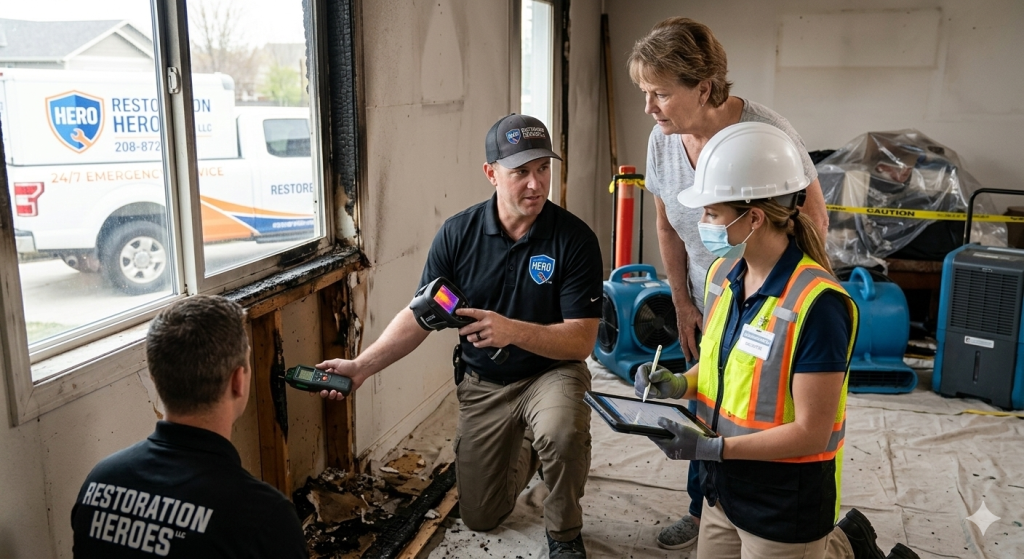
When the insurance adjuster visits your home, you want Restoration Heroes LLC on-site. Adjusters are often spread thin and may miss “hidden” damages such as:
- Moisture trapped behind baseboards or under subfloors.
- Smoke residue inside HVAC ducts.
- Structural weakening from high-heat fires.
We use advanced technology like thermal imaging cameras and moisture meters to provide the adjuster with scientific proof of damage. For more on the technical standards of restoration, visit the IICRC (Institute of Inspection Cleaning and Restoration Certification).
Step 5: Navigating Deductibles and Depreciation
Understanding the financial math of a claim is essential.
The Deductible
This is the amount you agreed to pay out of pocket. If your claim is for $10,000 and your deductible is $1,000, the insurance company will issue a check for $9,000. Note: You pay this amount directly to the contractor, not the insurance company.
ACV vs. RCV
- Actual Cash Value (ACV): The value of your items minus depreciation (age/wear and tear).
- Replacement Cost Value (RCV): The cost to buy the item new today.
Most modern policies are RCV, but companies often pay the ACV first and “hold back” the depreciation until you prove the repair is finished.
Common Reasons for Claim Denials
Even with insurance, denials happen. According to Forbes Advisor, common reasons include:
- Lack of Maintenance: If a pipe leaked because it was rusted for years, they may call it “wear and tear.”
- Exclusions: Many standard policies do not cover “Flood” (rising groundwater) or “Sewer Backup” unless you have a specific rider. Check FEMA’s National Flood Insurance Program for more on flood coverage.
- Waiting Too Long: Delaying your report can lead to denials.
Expert Restoration Services in Idaho
When your home is on the line, you need a team that acts fast and cares deeply. Restoration Heroes LLC serves our community with integrity, speed, and expert precision.
Contact Information
- Website: https://restoration-heroes.com/
- Phone: 208-872-4789
- Email: Restorationheroesllc@gmail.com
Join the Team
Are you a restoration professional looking for a new home? We are always looking for dedicated “Heroes” to join our crew.
- Career Inquiries: Restorationheroesllc@gmail.com
Conclusion: Take Control of Your Recovery
The restoration claims process is a marathon, not a sprint. By choosing a partner like Restoration Heroes LLC, you are ensuring that your home is handled with care and your insurance company is held accountable for the coverage you pay for.
For more information on disaster preparedness, check out the resources at Ready.gov or the American Red Cross.
Don’t navigate the storm alone. Let the heroes handle it.